Exercise: Picturing the Past
- Abbie Vidler

- Mar 15, 2024
- 2 min read
Brief
There are three options for this exercise. Choose one of the following to make:
An observational study of one object. This could be a vase, a piece of jewellery or an everyday object like a tool or piece of equipment – it doesn’t have to be a valuable ancient relic, but your object should be drawn in pencil and in as much detail and as realistically as possible, and document the physical and decorative attributes of the object, so it shouldn’t be overstylised.
A diagrammatic illustration. This could be a plan or an elevation of a space or place. Again this should be as accurate as possible, and could be drawn in pen or pencil. It could be diagrammatic or realistic, and it could be derived from aerial photographic reference or Google Earth. It can be a famous landmark, like part of New York’s Central Park, or an area known to you, like your home or local high street.
A pictorial scene. This option asks you to use your imagination more than the first two options. Look out of your window, or visit your local high street or another modern space. Take photographs or make sketches for source material. Now redraw this scene but, instead of a 20th century street scene, imagine how it would have looked in the past. This ‘past’ could be Victorian times, or the 1500s, or ancient times, or it could be a landscape of an ancient civilisation like Ancient Britain, China, Rome or Egypt. This option can be drawn in any medium, but still try to make it naturalistic rather than overstylised, as it should aim to be a representation of an earlier age in human history that is intended to be informational and authentic.
Whichever option you choose, the purpose of your drawing is to impart the significant information as clearly as possible, so try to make your drawing as accurate as you can. Your finished drawing should include colour.
Aim
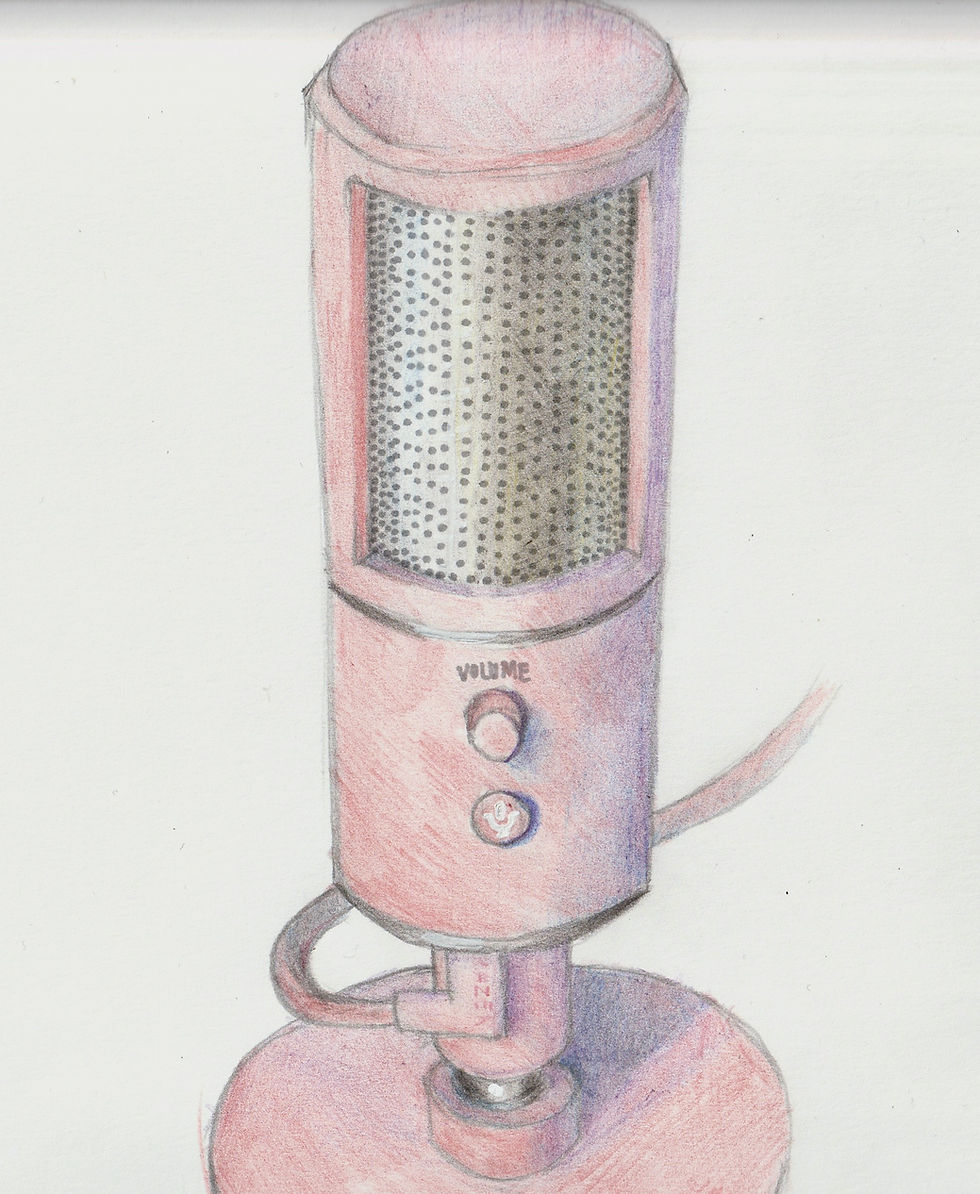
I'm going to create a observational study of one object, my microphone.

Observational study
In pencil I did two sketches of the microphones capturing the light and details in the design.

Final work
I used coloured pencils to create the final observational sketch, I lightly coloured and went in layers for the shadows in blues and purples. I avoided the pencil marks in the last sketches since it looks cleaner.

Evaluation
For this exercise, I sketched an observation of my microphone, I had to capture the object as I see it entirely-- without stylising it.
This exercise allowed me to improve my drawing skills, and had a focus of drawing detail. I prefer the sketches to the coloured illustration since I need to work on colour theory at the moment.
I feel like I did capture the entire object as I see it (minus the dirt on the microphone in the final illustration), this exercise was really relaxing to do!

Comments